Showing posts with label Research into thriller films. Show all posts

Saturday, 1 November 2014

Research into target audience - Miss Mller

We carried out this research to develop an idea of our target audience and their views on thriller films. From these questions we are able to uncover the opinions of the people who may be viewing this sequence. And by discovering their answers I can build a rough idea on what aspects of a thriller we should elaborate upon to make our clip as effective as possible. We asked a wide variety of 40 people to cover a large amount of views and opinions so we could get more assessed and reliable answers. We could then use these answers to make a more informed judgment call on the potential elements and ideas that could be included in our opening thriller sequence.

Questionnaire


1.How old are you?


2.what gender are you?


3.Do you enjoy thrillers?


4.What is your favourite element of a thriller?
For instance death, suspense, tension, shock, surprise, chase scenes, weapons and why?


 5. What type of thriller do you like?
Action, murder, stalking, psychological and why?


 6. What type of setting do you like/ prefer?


 7.Do you prefer thrillers which are relatable to your age group?


8. Do you think background music makes a thriller film more effective?


9. What type of weapons do you prefer?
E.g knife, gun, strength of the antagonist, or other.


 10. Do you like the effects of having a hidden identity within a thriller film?


Vox Pops

*Video's needed!

These videos were used to show more detail into the answers of my participants and there reactions to the various questions. It was very useful into showing answers for the more detailed and opinionative, open questions. It also added the reactions of people as they answer, emphasising what the target audience might understand and how deeply people are effected by various conventions of the thriller genre. Mainly ,however, it shows evidence of the interview style questioning used. 

 
Results :  


By asking people their age we can gather an idea of the audience we want to target. For example, if the majority of people who enjoy thrillers were under the age of 18 then we would create a clip attracting this age group. Therefore making the sequence more effective to the audience.


By finding out the gender of our potential audience we can discover what gender our story appeals to. This would therefore give us a clear view into what target audience we are trying to attract. Much like the question on age it furthermore gives an understanding in the audience we are targeting.   

This gives us a general insight into the type of people who want to watch thriller films and who are keen on experiencing their unique conventions. By looking at the type of people who said 'yes' and their age plus gender we can develop a more straightforward view at who the target audience we are aiming this thriller at.
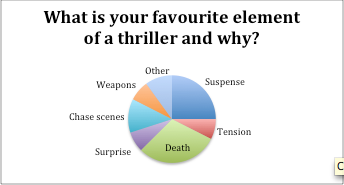
This is not a question particularly referring to the target audience it is more a general question used to show an overall perception of what are of a thriller people find more effective during a thriller. We can then build upon this element or convention to make the clip more effective. The results show that death is the most excitable and engaging part of a thriller film. We can now develop this part of the film, focusing on it and building up the suspense and tension around it, therefore creating a more effective appealing thriller.


This question also gives us an idea into how we can create a more effective thriller sequence, appealing greatly to the target audience. By asking for peoples preferred setting in a thriller we can see what setting may be best at building up the conventions of a thriller. The majority of people chose an 'isolated' setting as their more preferred setting. Reasons for this could be because an isolated setting shows the victim as being more vulnerable increasing the fear factor and the suspense as we want to see them survive. From this we may now use an isolated setting to present our suicide victim as looking more vulnerable and innocent to the audience. By doing this we can increase the suspense and tension as we see her in danger.
 
 This question was created solely on developing our target audience. By asking this we can build an idea of the age group we are going to target. The majority of people answered 'yes'. This means that we will try to create the clip based on the age group of the target audience. The effect this might have is that it means the audience can build a closer relationship with the characters, especially the victim, it therefore emphasises the effect of the typical conventions such as shock, surprise and suspense.
 

This questions helps greatly with the sound aspect of the film. It shows us how effective off screen music really is. Most people aid they were against background music, stating it has little effect. After looking at these results we may now cut down on the amount of background music used in this thriller. This could include using silence or the emphasis of diegetic sounds to build suspense and tension.


Death is a key convention in a thriller film. The murder weapon can interpret the type of death seen. The majority of people chose a knife as the favoured weapon used. From these results I will include a stabbing as the form of murder when the friendly, helpful protagonist is murdered. The knife used is a form of iconography. This can have a great effect on the audience. The knife results in a gory, painful death. This can exaggerate the hock convention, key to a successful thriller.
 

An idea we have developed for our thriller clip is the use of hidden identity for the antagonist. This was a key question for this research as we were keen on seeing the thoughts of the viewers and the opinion on its effect. The majority of people said that they appreciated the effect of a hidden identity. This will now have a great influence in the use of it in our clip. We will not see the identity of the antagonist throughout the film. This is one of the most effective ways of creating suspense and mystery during the clip, both key to a thriller, keeping the viewers engaged and entertained. It also builds up an enigma, this being atypical convention used in a thriller. Our clip will be based on this use of an enigma as we leave the audience asking questions throughout the sequence.

To conclude, there were various aspects discussed within the questionnaire that could prove to be useful for making my clip. One being the convention of death; the people I asked favoured this as the best part of  a thriller film. Now I know this I can incorporate it within my sequence by focusing more on the deaths that occur such as the death of our protagonist and the potential death of the victim. Furthermore the majority of people said a isolated setting is more effective in a thriller, this could be used by making sure the victim is often alone when vulnerable. I can also include the idea of setting the film on the idea of a relatable age group to the target audience, this was favoured in one of my questions.
In addition to this a knife was said to be the best murder weapon, meaning it is a great way to inflict shock upon the audience. Also we found out that off screen sound effects is not found to be effective when building suspense. This could result in is cutting down on the amount of off screen sound used and applying suspense through the effective use of silence; we may also use a knife as the antagonists murder weapon to create a larger sense of shock for the viewers. Most importantly the use of hidden identity was greatly favoured by the people asked. This element was key to my partners and I as we were keen on the idea and its effect of building a great amount of suspense. The fact that the target audience were also keen on the idea is very pleasing to us as we can now use it to great effect. The hidden identity of our antagonist should build up an enigma which keeps the viewers engaged, this is key to a opening sequence.


Monday, 13 October 2014

Research into convention - Miss Miller

Conventions

A conventions are elements that are common throughout different film genres. Thriller films contain various specific conventions such as; shock suspense death or an enigma. The clip I have chosen is from 'Scream' Reasons for this is that it is a highly successful thriller and shows typical conventions that are clear to the audience.


Firstly the film shows a younger girl as the victim and a mans voice for the antagonist. This is a typical convention of a thriller set from back in the 1940s when Alfred Hitchcock was prominent. The reason this is done is so that we can easily feel sorry for the more vulnerable, younger girl; however, we feel more scared of the powerful dangerous man. Therefore the audience support the young girl and the effect of the suspense and shock element in increased. A way this powerfulness of the man is emphasised is through various camera shots. A low angle is often used on the antagonist; by doing this it seems as though the villain is towering over the victim, therefore presenting him as menacing and powerful. The effect this has on the audience is that it inflicts pain upon us and we feel tension and suspense about the situation. The use of high and low angles are vital for the thriller as they help with the relationships built between characters and the audience and help way the audience into feeling tension as the victim is under threat.

Another a conventional form of cinematography often consists of the changes in tempo's within the thriller genre. This is clearly shown in this clip. There is an example of fasted paced editing from the start of this clip as the camera switches quickly from shot to shot, increasing the overall speed of the clip. The fast paced shots is generally used to present key moments within a film; the viewers get excited by the action and tension builds as we want to see the younger female survive. The fast tempo is often juxtaposed with slow tempo in various thriller works to emphasise a the suspense leading up to a shocking event; generally being a death. All being key to the entertaining factors of a thriller film.

Within the clip there is also a use of a plot twist towards the end of the video. The killer is seen to be linked with the victims friend. By doing this the producers build up an enigmatic theme to the film as the audience is left thinking about the plot and the outcomes. It is generally seen in most thriller films as it is what creates and develops the plot within a film. It creates a storyline of which the audience must slowly uncover what the outcome may be. An enigma is one of the best ways to create widespread suspense that builds up as the plot develops, this is why it is so important to a thriller film as suspense increases the fear factor and the overall entertainment of the piece of work. 

The iconography used in this clip furthermore presents the enigmatic conventions typically seen in a thriller film. Throughout the clip we see a mask used on the antagonist, this provides the killer with a hidden identity. Demonstrated in various thriller works, this creates an enigma. The audience are eager to discover the identity of the killer, therefore suspense is established as we build up towards finding out. A hidden identity is used throughout many thriller films. It is so highly orthodox to a thriller as it portrays the few emotions that are very conventional to a thriller. By leaving us thinking it creates a sense of mystery for the audience, as we are desperate to see the killer revealed it creates tension and suspense, also it can emphasise the shock and surprise element of further events in the film such as the death or the revelation of the hidden character. These emotions inflicted upon the audience are key to providing entertainment for a thriller.
 
Through these various techniques this film is made to be very conventional. It shows the senses of surprise, shock and suspense inflicted upon the audience. Surprise is conveyed through the plot twist shown, shock is shown by the quick change of shots as the antagonists springs up upon the victim and suspense and tension is built through the use of fast tempo, action packed filming. The main aspect of the clip I will take away and could use for myself is the use of an enigma. In my opinion this is the best way of engaging whilst creating a great amount of suspense and surprise. This sequence shows a clear view of how an enigma is used to great effect. 

Sunday, 12 October 2014

Opening sequence analysis- Miss georgiou

Halloween

An opening sequence sets a storyline for the rest of the film. It is used to engage the audience so that they want to watch the rest of the film and see what happens next. This is done by creating suspense and tension, plus presenting an enigma to the audience and making them think, therefore furthermore engaging them. This is shown in a great example during this film from the twist at the end shocking the audience and keeping them engaged.

Editing
The first form of editing I spotted was slow editing, this was shown as the antagonist slowly walks towards his victim. By slowing the camera work down the sequence is prolonged so that suspense can build up for the audience. By doing this a sense of tension is built as we are given time to think about what might happen next and prepare ourselves. This suspense built shows a typical convention of a thriller as tension is created for the audience building up to a shock moment. The tempo of this clip is used to various effects. It is also quickened after the murder has taken place to make it seem as though he is running away. This furthermore builds upon the tension created; however, it is used to a different effect as it excites the audience and puts them on the edge. By doing this the viewers become more engaged as they want to see what happens next.
Another form of editing used here is a reaction shot. This is shown when the mask is removed from the boys face and we see the colds face at the centre of attention. This has been done to emphasise the boys facial features and expression. The boys face was innocent and bewildered, this shows how he himself is confused into what has happened and it portrays this sense of confusion onto the audience. By using a jump cut from the dark, masked, frightening scene to the more colourful friendly scene of the young boy and his family; the sense of shock is emphasised as we go from seeing serious, dark, violent scene to being confronted with a friendly innocent child. The sense of shock is a general convention used in most thrillers.

Cinematography 
Cinematography is used to a great effect during this clip, mostly to emphasise the presentation of characters. The main form of cinematography used in this clip is POV. We see this whole clip from the point of the killer. This is done to engage the audience by putting us into the point of view of the antagonist. It shows us his actions, thoughts and a clear view of the death scene itself; by doing this it elaborates upon the shock, suspense and surprise factors which are key to a successful thriller. The main way in which this POV technique is used is to build upon the sense of suspense. This is done by hidding the identity of the antagonist. It builds up tension as we do not know how dangerous this character is. It creates an enigma. This is where the audience are left asking questions, as we don't know the identity of the character this enigma is introduced. It is a key convention of a thriller and one of the best ways to build suspense as it leaves the audience desperate to find out what is happening.
Another cinematography technique used during this clip is the use of camera angles. Much like the use of POV, this also emphasises the presentation of characters. When showing various characters throughout the clip a high angle is used to show them being beneath the camera. One way this is used is to show the female victim being stabbed by the murderer. It is used to present innocence and to emphasise to the audience how innocent the hound women is, This is a typical convention of the young female victim used in a thriller. The effect of this is that the audience find it easier to feel sorry for the victim, therefore increasing the effect of shock and suspense upon the audience. Another example of a high angle is used when the young boy is shown as the killer. The camera hangs above the boy elaborating upon his innocence and the surprised reaction of his parents. This furthermore presents innocence and creates an enigma for the viewers.
The effect of this enigma is exaggerated through the juxtaposition of both the camera angles and the POV technique. Firstly the POV angle is used to show the character being menacing and threatening. This is done by hiding the innocence indentity of the killer and presenting him as looking down on everything, through a low angle, in a dangerous and sinister manner. We are given an image of the character being a menacing, deadly, dangerous killer. This greatly affects the sense of shock and surprise as we see the innocent young boy through the high camera angle. This juxtaposition leaves the audience with and overruling sense of suspense, tension and confusion; forcing them to want to watch the rest of the film.

Sound

Various sound techniques are used throughout this clip, this is done to convey various emotions for the audience such as surprise, shock and suspense. It helps develop the orthodox thriller conventions during this clip. One of the main ways sound techniques are used is to build suspense. The clip does this through the use of silence. As the antagonist walks around and through the house not a noise is made. This silence makes it seem as though he is stalking his victim and doesn't want to be seen. It makes the audience wary of the dangerous antagonist and inflicts a sense of fear upon the viewers. The silence makes us alert for something important or dangerous about to happen, by doing this it makes the audience prepare themselves for a shock factor, this and the prolonged sequence builds up an immense amount of suspense. Another sound technique used to create suspense is the emphasis of the diegetic clock noises. This creates a slow beat elaborating upon the tension built. It could also symbolise the little time left of the girls life, in furthermore creates suspense everyone to see what happens to the girl. Suspense is used to keep the audience interested and increase the effects of shock.
In addition to this sound techniques are used to also elaborate upon the shock factor of the clip. One method used to do this is the parallel sound of a knife stabbing the woman. This emphasises the gory death of the young innocent girl. This quick gory death is a jolt to the audience and exaggerates the conventional emotion of shock. Also used to portray a sense of shock is the use of off screen music. At the start of the clip there is a friendly children's rhyme played in the background. This forebodes how old the antagonist could be and creates confusion for the audience, it could show how twisted the plot might be. It also creates an enigma as we think about why this music is being played. This creates tension and makes us watch on. Most importantly the technique increases the fear inflicted upon the audience. By the juxtaposing the friendly music with death it increases the shock factor as we see the dangerous, gory death of the young boys sister. The shock element engages and excites the audience.

Conventions

I have mentioned various typical conventions during this clip such as suspense, shock, female victim and more. Another convention used during this clip is the use of low key lighting. Examples of this is shown in the walk to and around the house. It is a typical for the convention as it creates a dark gloomy setting. The effect this has on the audience is that it builds mystery and tension as we do not know what exactly is happening. Another way this tension and mystery is build is through the camera focusing upon the house itself. This creates mystery about this house as the viewers think about what may be about to happen, this mystery element is key to a thriller.
The iconography used during this clip demonstrates various conventions generally used in thrillers. For example the knife and the mask hiding the killers identity. This is generally used to convey the suspense, surprise and shock key to a thriller. The effect the knife has on the audience is that it forebodes death and builds fear and suspense. The mask creates an enigma, furthermore elaborating upon the suspense built. These emotions are key into creating as successful thriller.

Summary 

There are various techniques I can take from this essay that might be useful in my film. The main convention I will use from this is an enigma. Throughout this opening sequence an enigma is created, this is exaggerated at the end by the plot twist used to confuse the audience. This is all done to keep the viewers engaged and keep them thinking. It is highly effective during a opening sequence as the engagement keeps people watching on. 


Sunday, 5 October 2014

Research into sound ( Mrs Miller )


In this piece of work I will be analysing the use of sound on a thriller film and the effects different techniques can have on the reader. I have chosen a sequence from ' the silence of the lambs ' to analysis. Reasons for this choice is the interesting different uses of sound during this clip having a strong effect on the viewers. Sound is very important to building the suspense, surprise and shock in a thriller which is key when creating a film from this genre.

One of the main techniques used I this clip is the contrapuntal music played as Hannibal attacks his victims. This is played throughout most of the sequence and has a great effect on the audience and the overall presentation of the character. The music played is peaceful, classical music. This is juxtaposed with the gory, vile scene taking place. The effect this has is that it creates a sense of confusion for the viewers . This confusion conveyed could be used to show the crazy, twisted, deluded character that Hannibal is. The fact he is listening to this happy peaceful music whilst eating and murdering the guards shows us how he actually enjoys it, therefore emphasising his psychotic mental state. By exaggerating Hannibal's deluded character, the audience is inflicted with the sense of fear as we see how dangerous he really is. It elaborates in the typical conventions of a thriller as we are surprised at this unorthodox way of killing somebody.

In this clip we are also shown the effects on screen sound can have on the viewers. This is shown at the start of the scene as the noise of the officers steps are exaggerated as they walk towards the jail. This builds a sense of suspense at the start o the scene. By emphasising the steps of the officers it could be showing how they are walking into a trap or even walking towards their death. It is foreshadowing what events are about to take place and therefore inflicting tension upon the audience. Small insignificant sounds like this are often elaborated in the thriller genre, this is mostly done to show the silence in the room. In this case the tension is emphasising the fear of the two policeman and giving the impression that Hannibal is a very dangerous man. By doing this the typical convention of suspense is conveyed throughout the start of the scene.

Another technique used to great effect is the diegetic sound used. An example of this is shown as Hannibal attacks the first police officer, He makes an animal-like growling sound as he bites the man. By making this sound he portrays the character as being inhuman and mentally insane. Through this the audience are given the sense of fear as they see how dangerous and unstable this character is. This builds suspense for further on as we become desperate to see him caught. Through doing this we are shown how sound can vastly effect the way in which the character is presented.

In addition to this the use of parallel sounds is shown in a great example throughout this scene. This is displayed through the reaction of the two officers as they attacked by Hannibal. the screams of the two men are emphasised during this part of the scene. This is the obvious reaction we are expecting after the attack from Hannibal and it clearly shows the fear the two men show. However by exaggerating it in this way it furthermore portrays a sense of tension and fright for the audience as we see how dangerous this man is. The expected convention of shock is illustrated through this as we are shocked to see the exaggerated reaction to Hannibal's violent and gory assault.

From this research I have seen the great effect that sound can have when creating a thriller sequence. Sound is vital when trying to present a certain character and can give the audience a lasting impression on that character. This is shown in a perfect examples as we are shown how unstable and twisted Hannibal's character is through the use of sound. It also makes it clear how important sound is in a thriller as it is vital to portray the protagonist in a fearful, negative light. Sound can inflict certain emotions upon the audience such as surprise, shock and suspense, this is done by emphasising certain sounds and adding music and noises, it is key to creating a successful, entertaining thriller film.


Wednesday, 1 October 2014

Research into editing styles ( Mrs Georgou )

Intro - Editing is essential for a thriller film as it means that they can cut out certain bits and pieces to build suspense, surprise and jump moments which are key for a thriller. The clip I have chosen is from the clip ' Human Centipede '. It shows a girl escaping the villain and gives a great example of the effect from timing in shots.


Shot reverse shot - This is shown as the camera switches quickly from one of the victims face to the other. It is used to highlight the facial expressions of the two characters and to compare the emotions they show. The two girls look scared and frightened by the doctor; by switching quickly from one expression to the other it emphasises the fear they show. Also the quick change of shots exaggerates the panic shown from the two girls and further more inflicts fear and tension upon the audience. The juxtaposition of the two girls creates a connection between them, showing they are both friends and are both petrified of the inevitable situation. This connection made between the girls elaborates the sympathy shown by the audience as people fear to see the two friends die.

Reaction shot - This is shown as the camera highlights the reaction the girl has to the operation taking place. The reason this form of editing is used is so that the characters facial expressions are exaggerated. The women is screaming, looking up and drastically wincing in pain, she is showing extreme pain. The effect this has on the audience is that we feel sympathy towards her, this emphasises the effect of what happens later in the film. The shot also conveys a sense of shock as we are shocked over the amount of torture the young girl was going through.

Timing of shots - As the action in the clip begins the timing of the shots speeds up. This exaggerates the intensity of the situation as the girl tries to escape. The fast movement between shots create a sense of panic, this engages the audience as we are desperate to see the outcome of the situation. The fast movements almost shows the adrenalin of the young girl; the conveys excitement for the audience as they are given hop that maybe she may escape the torturous situation, therefore furthermore engaging the viewers. In addition to this the shots become slower when she was about to be caught by the antagonist. This prolongs the section of the clip and builds up suspense over what could happen.

Jump Cuts - As the girl is trapped inside a room trying to escape the doctor the camera switches quickly from inside the room to outsdide. These jump shots can show both the docter and the girl in quick successions. By doing this it increases the speed of this section of the scene, creating as sense of panic and tension. It also contrasts the two characters by showing one as a crazy, deluded 'sick man and the other as an innocent, frightenined young girl. By doing this it elaborates the innocense of the young girl so that we feel sympathy for her. Thisn increaes the suspense as we want her to get away.

Sunday, 28 September 2014

research into cinematography ( Miss Miller )

Cinematographythe art of photography and camerawork in film-making.

During this essay I will discuss the cinematography of a certain clip: this includes the use of angles, movement and camera shots. The clip I have chosen is from The silence of the lambs. I picked this as it goes from a quiet scene to a lot more action. This provides various camera shos, angles and movements to analyse.


The first camera angle in the clip was a high angle shown at the start. This is where we were shown the police officer's from a higher angle in front of the lift. This higher angle makes the character seem smaller, as though we are towering over them. By doing this it makes the characters look vulnerable and weak. It also fore shadows what could happen. In this case the vulnerable police officers are deceived by Hannibal Lecter and they lose two of their colleagues. It conveys a sense of surprise as we see what should be organised, official police officers turn to be vulnerable and confused. This all intensifies the situation of the escaping Hannibal Lecter.

Secondly there was a use of a hand held camera shown as the police climb the stairs to investigate the shooting sound and missing officers.  As they ran along the corridor and ran up the stairs the camera switches to a hand held. The effect of this is that it highlights the panic of the situation: the sudden movement of the camera creates a sense of chaos for the audience. This emphasises the feeling of fear and suspense as the viewer is keen to find out what their reactions might be to the deaths of their partners. By creating chaos and panic it elaborates the danger of Hannibal Lecter and the importance of the situation. 

Also included in this clip was a zooming in camera movement on the lift dial. The dial shows where the shooter of the gun may have been or even where Hannibal might be. The fact the camera zooms in on it shows the audience that it is important. This builds up tension for the viewer as we find out Hannibal's where abouts and as we worry over his plans. In addition to this, by zooming in on the dial for this length of time it could highlight the fact that it is the center of attention in the room full of police officers. The fact that the movement of Hannibal is creating this huge sense of panic between the officers further more creates suspense for the audience as we see how dangerous he is.

A camera shot included in this sequence is an extreme close up. This is applied on one of the young police officers face to show his facial features. The police officer looks very scared and the extreme close up highlights this anxiety shown. This has been done to show his facial features in great detail, by doing this it emphasises the officers panic over the situation. All of this again shows the great danger of Hannibal and creates a sense of fear and suspense over what might happen. The close up also creates sympathy towards the young officer which exaggerates the effect that later events have on the audience. 

In addition to the forms of cinematography stated, the clip also included a point of view (POV) shot. This was used to show exactly what the officers can see as they enter the horrific death scene. It shows the gruesome image of the dead officer hung up over Hannibal's prison cell. The main reason this is done is to highlight what has happened with the death of the officers. It emphasises the horrific situation that the policeman are in. The shot means that we are put into the perspective of the officers, by doing this a relationship is built between the audience and the characters and a great sense of fear is created as we see the danger they are in.

To conclude, I think that the this sequence is mostly full of cinematography used to build tension and suspense for later events in the film. This is done by highlighting the anxiety of the police officers through showing their facial expressions and by highlighting the chaos of the situation. I emphasises the danger of the situation and builds upon the importance of Hannibal Lecter's escape being prevented. My analysis of the cinematography in this clip should greatly help me to highlight a facial features of characters and to create a sense of panic and chaos when it comes to creating my own thriller. 


Research into Mise on scene ( Mrs Georgiou )


Mise En Scene - the arrangement of scenery and stage properties in a play.

-Settings and iconography
-costume, hair and make up
-facial expression
-lighting

This is a certain scene from the film 'deliver us from evil' it shows various thriller conventions in this sequence.

Settings and iconography 

The setting in this scene is a dark enclosed prison cell, this creates a sense of suspense as the audience does not know exactly what is wrong with the possessed creature like character inside the cell. Also the bars surrounded the women shows she is dangerous and creates fear for the viewers.

Costume, hair and make up 

There is a large amount of work put into the presentation of the creature like women, this included costume hair and make up.  She is dressed in a hospital like gown, this could show us that she is ill and that something is wrong with her. It emphases the fact that she is dangerous and further more creates fear for the audience. The make up used on her made her seem ill and mentally twisted. Her face was made up to look battered, swollen, cut and bloody. the blood and cuts emphasise that she is dangerous and increase the fear put upon the audience. Her face is also made to look pale and white making her seem very ill and shows that something is horribly wrong with her. This is all done to create a sense of fear.

Facial expression 

The women in the jail was showing various deranged facial expressions putting a big impression onto the audience . She had wide eyes and an open mouth looking up at the man questing her. This made her look crazy, wild and creature-like. The expression shows us that the women is not mentally sane and makes her seem ill or possessed. This creates fear for the reader as she seems unstable, it puts the audience on edge. Although the main interrogator remains calm with a straight face throughout the clip his partner creates a different effect on the audience. He has a scared, worried expression, he looks vary of the deranged women inside the jail. These two characters are made to be the ones who the audience can trust and rely on. The fact he looks frightened by the women emphasises the viewers fear and anxiety. This fear builds a sense of suspense for the viewers as they are not sure what the women might do.

Lighting

In this clip low key lighting is used to create suspense and mystery over the creature-like women inside the jail. The lighting is coming from outside the jail, this creates a shadow over the women hiding many of her facial features and keeping many of the jail in the dark. The dark setting creates a sense of mystery about the character and builds upon the fear applied to the audience. As we cannot see the scene clearly the audience become more engaged as they want to see what will happen with the deranged women.

Evaluation 

By researching into Mise on scene I have realised how setting up and preparation of a scene is extremely vital into determining how the scene pans out. The lighting, presentation of characters and the setting itself can have a big effect on the audience, creating various emotions for the viewer. This is very important for creating the sense of suspense, shock and surprise which are crucial for a thriller. This research into Mise on scene has helped greatly with the preparation for my thriller as I now know various ways of preparing a scene to create fear, mystery and suspense which will added to my sequence. Examples of this include: the low key lighting, the deranged or frightened facial expressions and the enclosed setting emphasising the fear of the character inside.


Monday, 15 September 2014

Research into the BBFC - Mrs Miller

BBFC- British Board Film Classification 

Introduction 

The BBFC is a regulator of the moving image, its purposes are as follows:


  • To protect the public from content which might raise potential risks 

  • To provide the public with a way of making informed viewing choices 

  • To recognise and reflect adult freedom of choice 

  • To provide a cost effective, efficient classification service within our statutory responsibility
classification:

U stands for universal. A U film should be suitable for all audiences. Only a minimum amount of swearing should be allowed in this category. Sex references are forbidden and films must not include any sexual behaviour or nudity of any kind. The violence in these films must be very mild and will mostly depend on the context of the scene; however the outcome of violence will always end well and comfort the audience. Dangerous behaviour and use of drugs in a U film will generally be clearly disapproved of or punished in the film and should contain a educational message to children. Finally, U rated films are usually light hearted and easy to follow, they always end well with a positive conclusion. Some of these films may include Monsters Inc, Finding Nemo, or Toy story.


    PG - PG stands for Parental Guidance. This means it is unsuitable for younger children unless accompanied by an adult. The language in PG films may comprise of mild swear words. However, the context in which it is used it very important. For example, if the swear words are used in a threatening way, the film may have to be re-categorised to reflect this. There should not be a great amount of violence in a PG rated film, so while they may be some blood shown we should not see how the injury was inflicted in great detail. Furthermore, context of violence is also important; violence depicted in a more friendly context would be more acceptable. Any dangerous or antisocial behaviour which children could copy such as smoking, drinking, playing with electricity or bullying will go unchallenged or unpunished. There may also be mild or undetailed references to sex and sexual behaviour in a PG film. In addition to this, there may be small references to drugs. However, if drugs are referred to, there should be a clear anti-drugs message.

     
Films classified 12 and 12 A may contain material that is not suitable for a child under the age of 12. Any child under the age of 12 may only see this film if accompanied by adult, whether the film is suitable for the child is the adults reasonability. 12 films that are light hearted and positive may be more likely to pass for a 12A than a dark violent serious piece of work. The use of strong language is a lot less strict in a 12 than a PG, however the classification strongly depends on the context in which the language is used. Sex and sexual behaviour may be briefly shown in a 12 rated film, however it may not be in detail and comedy would lessen the effects. Nudity may be shown, however very discreetly. Moderate violence may be seen in these films, however shall not be dwelled upon. Any injury or blood shall not be focused on. Drugs and bad behaviour shown in a 12 will not be put in detail or endorsed in anyway, plus any misuse of drugs in a film ill not be glamourized and may even be seen punished in the movie. To conclude, 12 and 12A rated films will be made to be entertaining for a teenager or older and therefore may include the use of violence, sexual references and maybe even use of drugs; however, none of this will be dwelled upon and the film should not promote bad influences upon the younger audiences. A 12 film almost always ends well with the protagonist or the 'good' person coming up on top and a happy successful ending being shown. Examples of 12 rated films include; many of the James Bond series, various Marvel films such as the Avengers and Avatar.


 15 means that nobody under the age of 15 should be able to see this film, especially in the cinema. Strong language in a 15 rated film is not usually restricted, only if used continuously throughout a film may it be thought upon. A film of this classification shall also not endorse and discriminatory language, this must not be promoted. Sex and sex references are generally accepted at this category. The only restrictions ,may be that it must not be shown in detail and must be backed by the context. Strong violence is shown at this rating, however the film must not show the injury in detail and will not include any gory scenes. Verbal incidence of sexual violence is usually accepted, however physical sexual violence is generally frowned upon and not accepted. The use of drugs may be used in a 15 rated piece, this must not be focused on and should not be promoted or endorsed. The behaviour shown these films could be dangerous or unacceptable, but like other restricted features it should not be shown in a positive manner. Overall a 15 film should be an exciting and should keep the audience on edge. It may also have to keep the audience entertained through comedy or romance, with the older aged audience that may include using censored, restricted material to keep the viewers engaged.


An 18 piece is generally made for adults; restricted to anyone under the age of 18. In this classification there are hardly any limits on the restriction guidelines. The use of strong language is permitted and may be used frequently and aggressively, influenced by violence. There may be racist comments and discriminatory terms in an 18 film. However, the film as a whole must not break the law and breach any legislation regarding racism. Full nudity can be featured even when not in an educational capacity and 18 films can show a real sexual act. As long as it is not in a strong pornographic context. During an 18 film violence can be aggressive and be conveyed in strong detail. Pain or injury can even be focused on. The most graphic, gory images are allowed within this category . Drug use and reference are permitted to be shown during an 18 rated film but like other classifications drug must not be promoted or encouraged. Though these films and videos may cover contentious and dangerous subjects and themes, public safety is still a consideration. Very dangerous or criminal behaviour which could encourage copy-cat crime and therefore pose a risk to people's safety may be cut from the film before release. To summarise films with this classification contain detail that only appeals to adults and would shock and scare younger viewers. 18 films do not always have a good, happy ending. The plot may be twisted or unpredictable and need adult interpretation. Examples of 18 rated films are Wolf of Wall Street, The Halloween series and Good Fellows.

To conclude, although the restriction on content changes throughout the classification, the overall purpose of the controls remain the same. No dangerous behaviour that could be copied by a vulnerable audience is promoted the categories, such as the use of drugs, dangerous behaviour that could be copied by teenagers or even just images that may influence people into risking their own well being. The tone of film is the element that drastically differs throughout the classifications. A U is light hearted, humorous and will always end well, a 15 however may be darker and contain more censored material but will remain suitable to a teenager and an 18 can be extremely dark and gory or contain highly sensitive material that could have a highly serious element to it. This variation in tone emphasises how strict these guidelines should be and how the films differ throughout the spectrum.